
Home / blog
JSawai Madhopur is the kind of place most people plan around a tiger sighting. And that's fair. But there's more to this town than the forest gates — old temples, a UNESCO-listed fort sitting inside the jungle, a quiet riverside, and a pace of life that feels genuinely unhurried once you step out of the city.
Getting there from Jaipur is easy. A Jaipur to Sawai Madhopur car rental puts you on the road for roughly 3 to 3.5 hours, and unlike trains, you're not tied to a timetable. Safari slots open early. Your cab leaves when you're ready — not when the schedule says so.
Our Jaipur to Sawai Madhopur taxi is available every single day. Families going for a weekend jungle stay, photographers targeting a specific zone, honeymooners who want something quieter than Jaipur's chaos — we've sent cabs for all of it. Every vehicle is AC, well-kept, and driven by someone who knows exactly how to reach the Ranthambore gate without a detour.
Shristi Holiday Services handles booking, vehicle, and driver. You just pack and leave.
The Jaipur to Sawai Madhopur distance by road is around 175 to 185 kilometres. Most of the stretch runs along NH 52 through Dausa, Lalsot, and Karauli before the road drops into Sawai Madhopur. On a regular morning, you're looking at 3 to 3.5 hours behind the wheel.
Early departures — 5 AM or so — are faster. City traffic is thin, the highway is open, and you reach Sawai Madhopur just as things are coming alive. If your safari slot is the morning shift, this is the only sensible way to go.
Our Jaipur to Sawai Madhopur cab service follows this NH 52 route on every booking. It's direct, predictable, and avoids the kind of diversions that eat into your time near the park.
Pick the vehicle that fits your group. Below are approximate one-way fares.
| Vehicle Type | Model | Seating | Approx. One-Way Fare |
|---|---|---|---|
| Hatchback | Wagon-R / Indica or similar | 4 Seater | Rs. 1,800 – 2,200 |
| Sedan | Dzire / Etios / Xcent or similar | 4 Seater | Rs. 2,000 – 2,500 |
| SUV | Ertiga / Xylo or similar | 6 Seater | Rs. 2,800 – 3,500 |
| Premium SUV | Innova / Innova Crysta | 6-7 Seater | Rs. 3,500 – 4,500 |
| Tempo Traveller | 9 to 14 Seater | Large Groups | Rs. 5,500 – 8,000 |
| Force Urbania | Force Urbania or similar | 10-17 Seater | Rs. 6,500 – 9,500 |
Prices can shift a little with fuel rates and peak travel months. Whatever we quote at the time of booking is what you pay. Nothing extra after the trip.
A round-trip cab from Jaipur to Sawai Madhopur works out cheaper than two separate bookings if you're coming back the same day.
Ranthambore National Park is the obvious starting point. A tiger reserve spread across 1,334 square kilometres, it's home to Bengal tigers, leopards, sloth bears, nilgai, marsh crocodiles, and somewhere around 300 bird species. The park doesn't look like a typical forest — it has lakes, ruins, and rocky ridgelines cutting through the trees. Zones 1 to 10 cover core and buffer areas, and each zone feels different depending on the day and season.
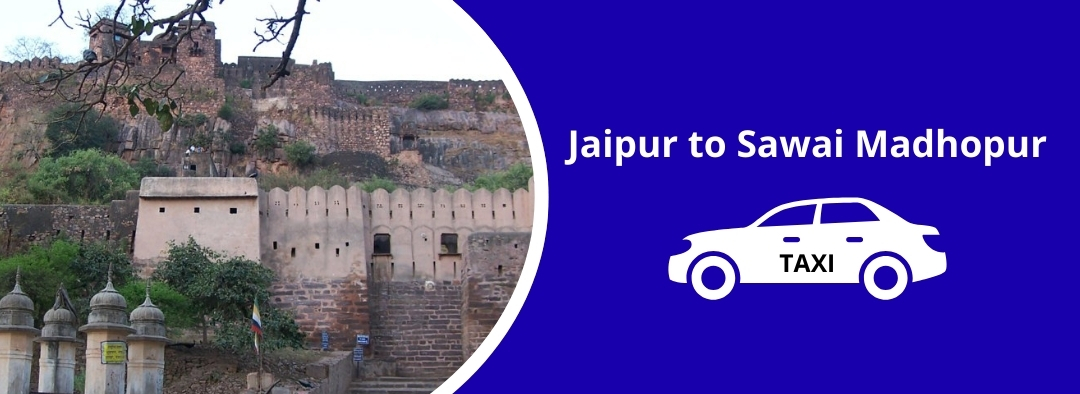
Ranthambore Fort stands on a hill inside the forest and it's a UNESCO World Heritage Site. Built by the Chauhan rulers over a thousand years ago, the fort offers a wide view of the park below. The trail to the top passes through forested paths and wildlife is often seen along the way. Tigers have been spotted near the fort more than once.
Trinetra Ganesh Temple sits inside the fort complex and is one of the more unusual Ganesh shrines in Rajasthan. Devotees across India send their wedding invitations here by post as an offering before distributing them to family. It's been a practice here for generations.
Padam Talab is the biggest lake inside the park. Early mornings near this water body are among the most productive windows for wildlife activity. Tigers come to drink, crocodiles bask along the edge, and waterbirds gather in numbers that shift by season.
Jogi Mahal is a small historic rest house near Padam Talab. What most people notice first is the enormous banyan tree beside it — believed to be over 800 years old and genuinely one of the widest you'll see anywhere in the country.
Raj Bagh Ruins are what's left of an old royal garden. The jungle has taken most of it back. Deer and peacocks move through the crumbling walls and it photographs well at almost any hour.
Surwal Lake is a little outside the main park area but worth knowing about. It's a seasonal lake that draws large flocks of migratory birds between November and February. Birders specifically come to Sawai Madhopur for this spot.
The park stays open from October through June and shuts down for the monsoon from July to September.
October to February is the most comfortable stretch to travel. Mornings are cool, the dry undergrowth makes animals easier to track, and migratory birds arrive in good numbers. First-time visitors almost always come during this window and most of them leave satisfied.
March through May is harder on the body but softer on patience when it comes to tiger spotting. Water dries up, animals concentrate near what's left, and sightings climb. Wildlife photographers who've been to Ranthambore multiple times often prefer May specifically because the forest floor is bare and nothing hides.
June is the final month before the gates shut. Hot, but quieter. The park sees fewer vehicles and that sometimes works in your favour near water sources.
For a first trip, from November to February. For a tiger-focused trip, March and April.

Starting From ₹17/Km

Starting From ₹35/Km

Starting From ₹95/Km